
Are you a parent in Kenya trying to make sense of the Competency-Based Curriculum (CBC)? If your dining table has turned into a makeshift art studio for strange homework assignments, or if you find yourself baffled by terms like "stranded strands" and "community service learning," you are definitely not alone.
The shift from the 8-4-4 system to CBC has been nothing short of a revolution in Kenyan education. For parents, it has been a journey marked by confusion, frustration, but also moments of pride as we watch our children apply what they learn in real life.
As a parent navigating this system myself, and having keenly observed its implementation over the last few years, I have compiled this comprehensive guide to help you understand exactly what CBC is, why it’s here, and how you can best support your child without losing your sanity.
What Exactly is CBC?
Let’s strip away the education jargon. The old system, 8-4-4, was largely "cram and pour." Students memorized facts to pass exams. The focus was on getting a high grade to secure university entry.
The Competency-Based Curriculum (CBC) is different. It focuses on what a child can do rather than just what they know.
It is a shift from rote learning to practical application. The goal is to produce an engaged, empowered, and ethical citizen. The curriculum is designed to identify and nurture a child’s unique talents and interests from a very young age.
Instead of just being told how a battery works, a Grade 4 learner under CBC might actually build a simple circuit. It’s hands-on, and yes, it often involves a lot of parent participation.
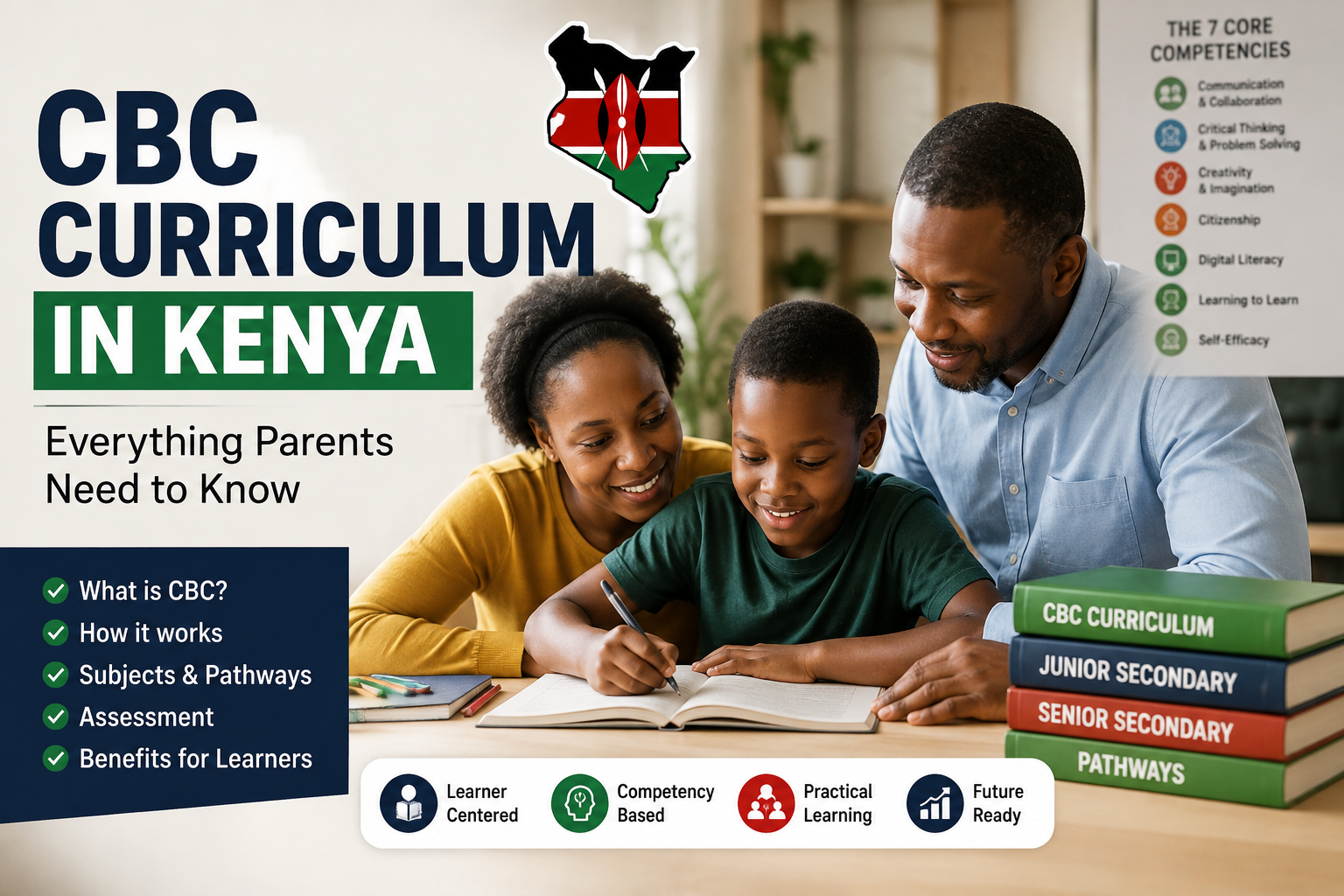
The Structure: Why 2-6-3-3-3?You’ve probably seen this number sequence everywhere. It represents the years learners spend at each level.Early Years Education (Pre-primary 1 to Grade 3)Focus: Foundational skills, play-based learning, and discovering talents.Key Learning Areas: Literacy, Mathematical Activities, Environmental Activities, Psychomotor and Creative Activities.Assessment: No national exams. Evaluation is continuous (classroom activities).Middle School Education (Grades 4 to 9)Focus: Exploration and application of knowledge.The Shift: This is where many parents feel the pressure increases. Subjects become more distinct.Assessment: This level is split into two:Upper Primary (Grades 4-6): School-based assessments and a national assessment at Grade 6 (Kenya Primary School Education Assessment - KPSEA).Junior School (Grades 7-9): A crucial transitional phase where students explore various subjects before choosing a pathway in Senior School.Senior School (Grades 10 to 12)Focus: Specialization. This is equivalent to the current Form 1 to Form 3.The Big Change: Students will choose a career pathway based on their interests:Arts and Sports ScienceSocial SciencesScience, Technology, Engineering, and Mathematics (STEM)Tertiary Education (University/College - 3 Years)Focus: Specialization in a chosen career field.Understanding CBC Assessment: Goodbye RankingOne of the biggest shifts is how children are graded. In 8-4-4, it was all about the final KCPE or KCSE score. In CBC, the focus is on Assessment for Learning rather than just Assessment of Learning.1. Formative Assessment (Continuous)This happens daily in the classroom. Teachers observe your child as they do projects, ask questions, and interact with others. These small, regular assessments build up to a final score.2. Summative Assessment (National)Contrary to popular belief, exams still exist.At Grade 6 (KPSEA): Students sit for a national assessment. However, this doesn't mean "pass or fail." It is used to monitor the curriculum's effectiveness and helps in placement to Junior School.At Grade 9: Another national assessment will happen to guide placement into Senior School pathways.3. The Grading Scale (Performance Levels)Instead of marks (e.g., 400/500), learners are graded on a scale of 1 to 4 based on their mastery of skills:Exceeding Expectation (4): The learner can apply the skill exceptionally well in unfamiliar situations.Meeting Expectation (3): The learner has acquired the skill and can apply it correctly. This is the expected level of mastery.Approaching Expectation (2): The learner is beginning to understand and apply the skill but needs more practice.Below Expectation (1): The learner has not acquired the skill and needs significant intervention.The Parent’s Role: Why You Are Now a "Co-Educator"Let’s be honest; this is the most controversial part of CBC. The curriculum demands significant parental involvement.Teachers will often send homework that requires you to help your child find materials, build something, or interview a grandparent. While this can be exhausting after a long day at work, it is intended to bridge the gap between school and home life.Practical Tips for Surviving CBC Homework:Embrace "Junk Modeling": Much of the creative activities don't require expensive materials. Start collecting bottle tops, old cartons, matchboxes, and fabric scraps. Your child’s creativity is more important than a polished, store-bought look.Guide, Don't Do: The temptation to finish the project for your child is huge so that they can get a "4." Resist it. Let them struggle with the glue and scissors. Your role is to facilitate, supervise, and ask guiding questions.Communicate with the Teacher: If a homework assignment seems impossible or requires resources you don't have, talk to the class teacher. They are usually open to alternatives.Engage in Parental Digital Empowerment (PDE): Some assignments require research. As a parent, you need to guide your child safely on the internet to find information.Real Examples of CBC in ActionTo truly understand CBC, it helps to look at actual learning activities versus the old system.Subject AreaOld System (8-4-4) ApproachCBC ApproachScience (Lower Primary)Memorizing parts of a flower from a textbook diagram.Planting a bean seed at home, observing its growth daily, and drawing the changes.Hygiene & NutritionAnswering multiple-choice questions about healthy foods.A practical activity where the child helps prepare a simple fruit salad in class.Social StudiesListing the roles of a chief from a textbook.Visiting the local chief's office (with parents) and interviewing the chief or an assistant about community leadership.MathematicsCalculating abstract sums repeatedly.Using bottle tops to understand grouping and addition physically.Community Service Learning (CSL) and PathwaysAs students enter Junior School (Grade 7 onwards), the curriculum introduces Community Service Learning (CSL). This is a fantastic initiative designed to build character and social responsibility.Learners are required to undertake projects that benefit the community, such as cleaning a local market, planting trees, or visiting a children's home. They are required to write reports on these experiences.By Grade 10, students must choose a pathway. This is why it is crucial for parents in Junior School to pay close attention to what their children enjoy and excel at. Are they fascinated by computers and building things (STEM)? Do they love history, languages, and debate (Social Sciences)? Or are they passionate about music, drama, and sports (Arts and Sports Science)?Final Thoughts: Navigating the ChallengesIt hasn't been a smooth ride. The introduction of CBC has faced criticism regarding inadequate teacher training, the high cost of materials for parents, and congestion in classrooms.However, the world is changing rapidly. The skills needed for the 21st-century workplace—critical thinking, problem-solving, creativity, and collaboration—are exactly what CBC aims to instill. Memorizing the date Kenya got independence is less important today than knowing how to use that knowledge to foster national unity.My advice to you, fellow parent: Take a deep breath. Lower your expectations of perfection for your child’s homework. Focus on the joy of discovery they show when they finally figure out how something works. Engage with the teachers, connect with other parents, and embrace this new way of learning. It’s a marathon, not a sprint.Quick Summary for Busy Parents:What is it? Practical, skill-based learning.How are they graded? Levels 1-4 (no ranking).Exams? Yes, KPSEA at Grade 6 and another at Grade 9.Your role? Facilitator and co-educator.The goal? Nurturing individual talents for the modern world.Frequently Asked Questions (FAQs)Here are quick answers to common questions parents ask about the CBC curriculum.Is CBC replacing 8-4-4 completely?Yes. The 8-4-4 system is being phased out. The last KCPE exam was sat in 2023, and the last KCSE exam will be in 2027. All learners are now transitioning through CBC.Is there still homework in CBC?Yes, but it is referred to as "Home Assignments" or "Learning Activities." It is meant to be engaging and often involves practical work rather than just writing.Do children still wear school uniforms?Yes, the uniform requirement is determined by individual schools, not the curriculum itself.How can I help my child if I don't understand the content?You don't need to be an expert in every subject. Your role is to provide a conducive environment, resources (often recycled materials), and encouragement. You can also learn alongside your child; many parents admit to learning new things through CBC.What happens if my child fails the Grade 6 assessment (KPSEA)?There is no "fail" in KPSEA. The assessment is used to identify areas where the learner needs support as they transition to Junior School. It does not lock them out of progressing to Grade 7.
🏷️ CBC Curriculum